
Medical AI is a healthcare AI company that analyzes biosignals using artificial intelligence to predict and diagnose conditions that are difficult to identify through conventional medical approaches.
Why Medical AI Adopted Global Security Certifications
From the outset, Medical AI has prioritized customer trust. As its services scaled and its customer base expanded across industries, expectations around information security and data privacy grew accordingly.
While the company had continuously strengthened its internal security framework, global customers and enterprise partners increasingly required externally validated standards. Certifications such as ISO 27001 and CSA STAR, along with objective assurance, became key evaluation criteria. At the same time, regulatory scrutiny intensified, with growing demands to demonstrate compliance with frameworks such as the EU GDPR, U.S. HIPAA, and Japan’s APPI. In response, Medical AI implemented a security management system aligned with global standards and pursued internationally recognized certifications.
This enabled the company to formally validate its security capabilities and establish greater trust from the early stages of client engagement.
Challenges and Outcomes
At the outset, Medical AI focused on gaining a clear, organization-wide view of its security posture. This included reviewing the adequacy of policies and procedures, assessing log and evidence management, and evaluating security controls across development, deployment, and operations.
Based on these findings, security processes were refined through cross-functional discussions to better align with actual workflows, leading to a more standardized management system. The company then strengthened its documentation and operational evidence while carrying out regular reviews and improvements.
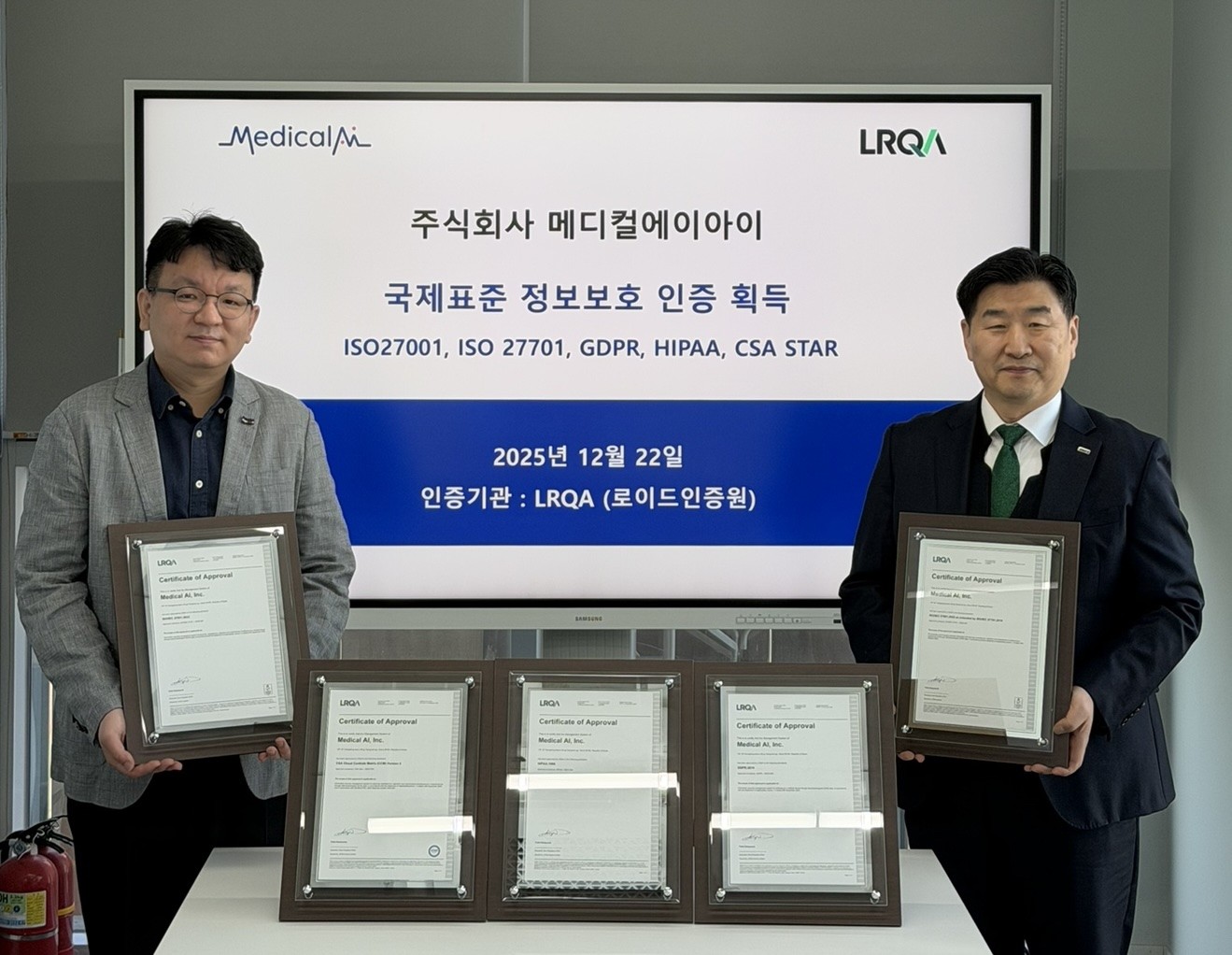
Partnership with LRQA
After evaluating several certification bodies, Medical AI selected LRQA for its strong global track record and extensive audit experience. Its deep understanding of cloud-based services and SaaS environments was a key factor in accurately reflecting Medical AI’s architecture and security requirements throughout the audit. Rather than focusing solely on compliance, LRQA provided practical insights into the effectiveness of security controls and more efficient ways to operate them, offering actionable recommendations during the process.
Future Plans
This certification marks a milestone and a new starting point for Medical AI. With a security framework aligned with international standards in place, key regulations such as the EU GDPR, U.S. HIPAA, and Japan’s APPI, along with industry-specific requirements, are being proactively incorporated into its security processes, while customer requirements and feedback are systematically managed.
In addition, the introduction of automated workflows to verify regulatory compliance during service changes is under review, enabling a more effective response to evolving domestic and global regulations and market demands. Through these efforts, information security and data privacy are positioned beyond compliance as a core competitive capability, further strengthening a foundation of trust for customers
Discover LRQA's information security services